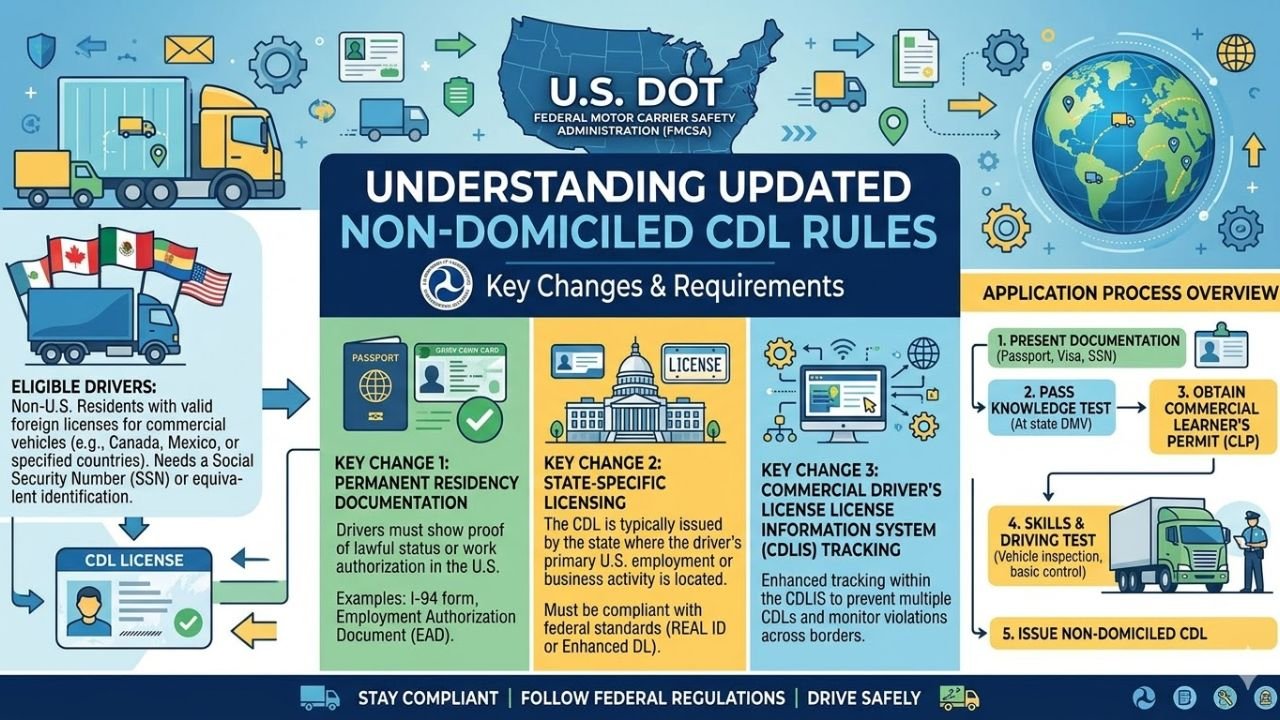
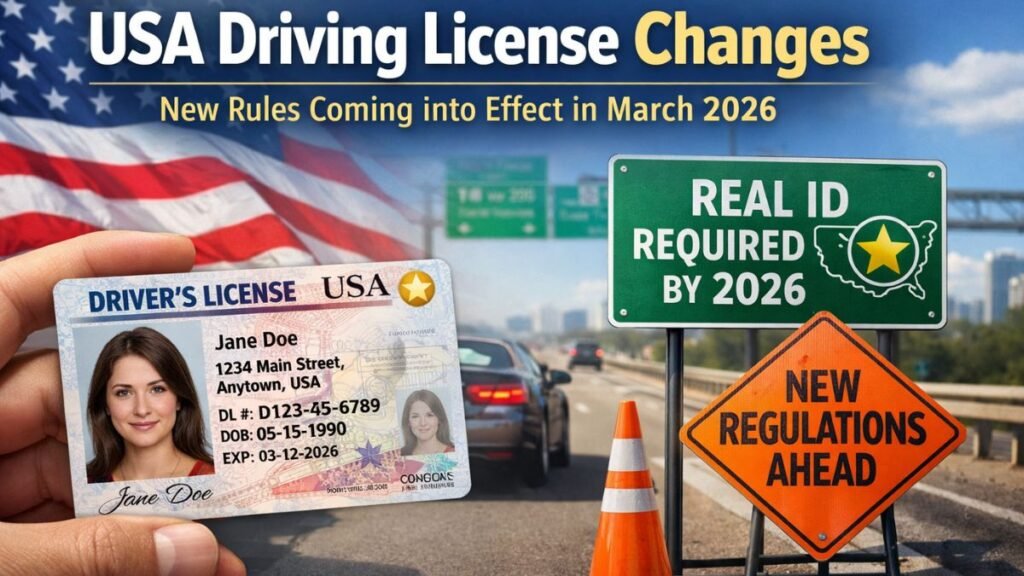
The American trucking industry is undergoing a major transformation following new federal guidelines targeting non-domiciled Commercial Driver’s Licenses (CDLs). These changes, introduced by the U.S. Department of Transportation (DOT) and the Federal Motor Carrier Safety Administration (FMCSA), aim to strengthen safety standards and eliminate regulatory gaps.
On February 13, 2026, the FMCSA issued its final rule titled
“Restoring Integrity to the Issuance of Non-Domiciled Commercial Driver’s Licenses.” The rule officially took effect on March 16, 2026, marking a significant shift in how commercial licenses are issued to foreign drivers.
Why the New CDL Rule Was Introduced
The new regulation is designed to address what officials describe as a “safety gap.” Previously, non-domiciled drivers could obtain CDLs without undergoing the same rigorous background checks required for U.S. citizens and lawful permanent residents.
Under the updated rule, all CDL holders operating heavy commercial vehicles—often weighing up to 80,000 pounds—must meet stricter verification and safety standards aligned with U.S. compliance requirements.
Key Changes to CDL Eligibility
One of the most significant changes is the elimination of Employment Authorization Documents (EADs) as a valid form of eligibility. Previously, drivers could use an EAD alongside other documents to obtain a CDL. This is no longer permitted.
Moving forward, only individuals with specific non-immigrant, employment-based visa statuses are eligible to apply for, renew, or transfer a non-domiciled CDL or Commercial Learner’s Permit (CLP). These include:
- H-2A Temporary Agricultural Workers
- H-2B Temporary Non-Agricultural Workers
- E-2 Treaty Investors
As a result, individuals with statuses such as DACA, asylum, or Temporary Protected Status (TPS) will no longer be able to renew their commercial licenses once they expire.
Stricter Verification Requirements for States
State Driver’s Licensing Agencies (SDLAs) must now implement enhanced verification procedures. A key requirement is the mandatory use of the SAVE (Systematic Alien Verification for Entitlements) system to confirm an applicant’s legal status at the federal level.
Additionally, all CDL applications and renewals for non-domiciled drivers must be completed in person. States are no longer allowed to process these transactions online or by mail.
State officials must also verify documents such as foreign passports and I-94 records in person. Records must be retained for two years and made available to federal authorities within 48 hours upon request.
Comparison: Old vs New CDL Rules
| Requirement |
Previous Standard (Pre-2026) |
New Rule (Post-March 16, 2026) |
| Accepted Documents |
EAD or Foreign Passport |
Foreign Passport + I-94 (Visa-specific) |
| Eligible Statuses |
Any valid work authorization |
Only H-2A, H-2B, and E-2 visas |
| Verification Method |
State-level review |
Mandatory SAVE system check |
| License Expiration |
State discretion |
Tied to I-94 (max 1 year) |
| Renewal Process |
Varies (some online) |
In-person only |
Safety Concerns Driving the Rule
The regulation was influenced by a series of fatal crashes in 2025 involving foreign drivers. According to federal data, 17 crashes resulted in 30 deaths, and those drivers would not meet the new eligibility standards.
The rule also introduces stricter English language requirements. Drivers must demonstrate the ability to understand traffic signs and communicate effectively with law enforcement. Failure to meet these standards can result in immediate removal from service.
Legal Challenges and Industry Impact
The rule has sparked legal challenges and industry concerns. Critics argue that it unfairly affects lawfully present workers with clean driving records. Some estimates suggest that up to 194,000 drivers could be impacted.
Opponents also note that non-domiciled drivers account for only a small percentage of fatal crashes. However, federal officials maintain that the rule will have minimal long-term disruption and emphasize the importance of proactive workforce planning.
What Employers Need to Do
Trucking companies are advised to audit their driver workforce to ensure compliance with the new visa and licensing requirements. Failure to prepare could lead to license downgrades and operational disruptions.
The new rule also eliminates “forum shopping,” ensuring that all states follow uniform standards, thereby increasing trust in the commercial transportation system.
FAQs
Q1 Can I still use an EAD to renew my CDL?
No. As of March 16, 2026, EADs are no longer accepted. Applicants must provide a foreign passport and an I-94 with H-2A, H-2B, or E-2 status.
Q2 Will my current CDL be canceled immediately?
No. Existing licenses remain valid until their expiration date. State agencies will notify drivers if any action is required.
Q3 What if I have a different visa?
Individuals with visas outside the approved categories—or with statuses like DACA or TPS—are not eligible for renewal under the new rule.